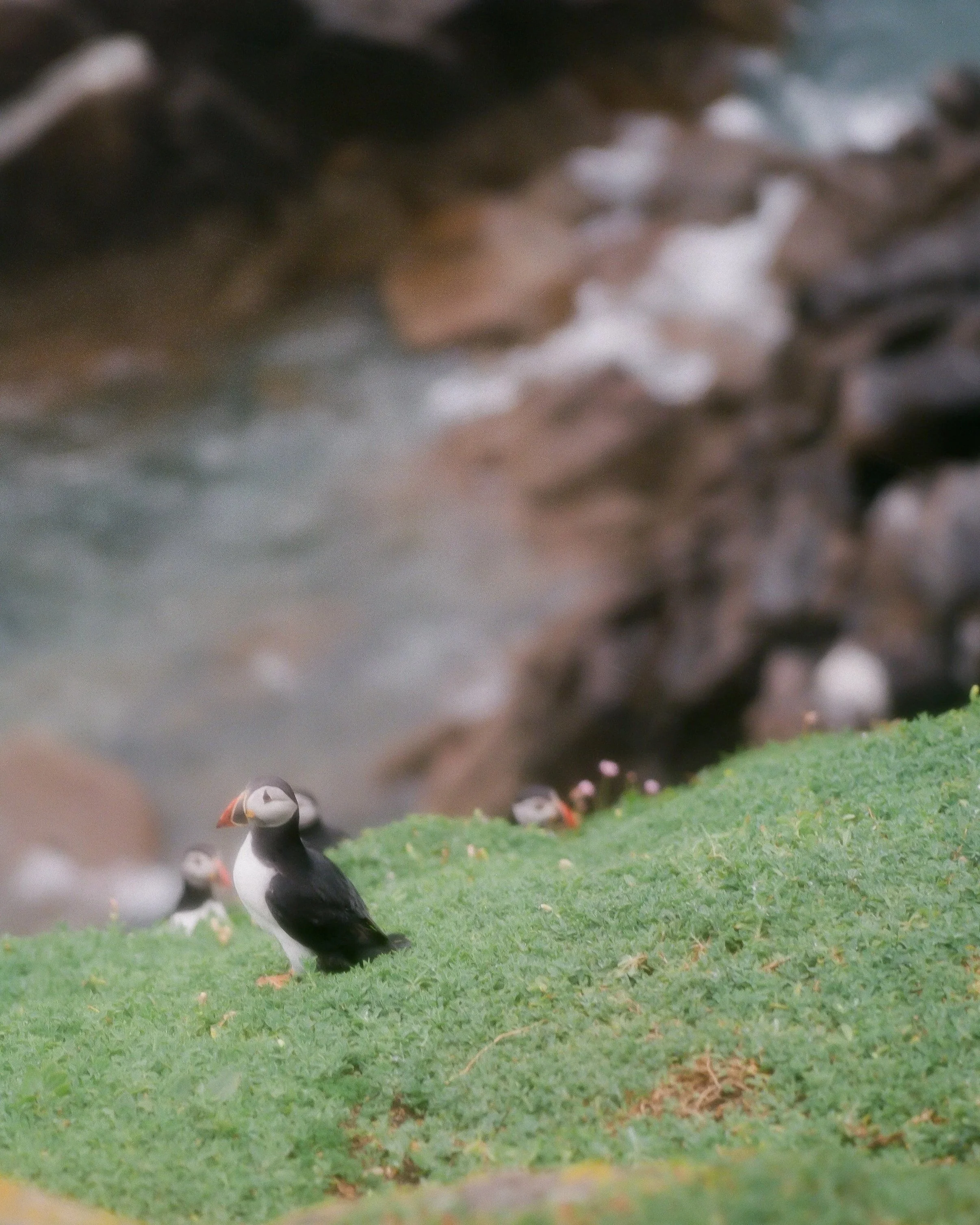
Puffins & other things

Atlantic Puffins
Who are the puffins, and why are they special?
Puffins are considered highly charismatic birds with distinct personalities. Ecologically, they are one of the seabird species inhabiting the Atlantic and play a vital role in the ecosystem as ecological engineers through their burrow construction, which alters soil composition and transports marine nutrients—via their fish-based diet—to coastal ecosystems. As seabirds, which are top marine predators and sentinel species, they are indicators of the health of the ocean.
“Goofy” as puffins may seem, they display a high level of intelligence (by human standards), as evidenced by their sociability—the very trait that makes them such amusing birds to the eyes of humans. Puffins are naturally curious, and at times, this trait can lead them into trouble. For instance, a puffin might wander too close to another’s burrow, only to be aggressively chased away. When a fight breaks out, other puffins, being rather nosy little birds, often gather around the commotion to watch the rumbling and tumbling, even when things become rather violent.
Such expressions of curiosity extend to billing as well. A pair may engage in the ritual known as “billing,” in which they rub their bills together to strengthen their bond. When this occurs, another puffin may approach to observe or even attempt to join in—often without peaceful consequences, as the third puffin is, once again, driven off by force. Additionally, puffins gather on rocky cliffs within their colonies, sometimes referred to as “party rocks,” where they socialise.


Let’s get to know them with some factual information.
Puffins (Fratercula arctica) are seabirds in the auk family. They can live up to 25 years and are known to mate for life, with a very low divorce rate. Each year, puffins lay a single egg, and both parents share the responsibility of incubating and raising their chick—known as a puffling—in their burrow. Puffins remain ashore during the warmer months of spring and summer, before heading out to sea as the season ends.
During the breeding season, Atlantic puffins nest in colonies, burrowing into small, rocky islands with short vegetation. These islands tend to have fewer land predators, such as foxes, rats, stoats, and feral cats; however, puffins remain highly vulnerable to these invasive species, which are among the most significant threats to them. Puffins share these islands primarily with guillemots (common murres), razorbills, and kittiwakes. Seagulls, along with skuas that practise kleptoparasitism, also pose threats by preying on pufflings and stealing puffins’ food.
Despite these risks, puffins have relatively few natural predators, aside from seals, which are also known to prey on them. Being generally docile and curious, puffins are not easily frightened by humans. If approached, they may walk or fly away, but when kept at a reasonable distance, they will usually go about their day around their burrows. They do not necessarily shy away from human presence.
That said, it’s essential to keep away from their burrows! Being too close to the birds’ burrows puts the safety of the birds and their eggs at risk from disturbances and footfalls. You should not touch the puffins. Touching them is very harmful, as their feathers possess special properties that deflect water, and petting them compromises this. Most importantly, it is crucial to note that human intrusion has been one of the causes of nest desertion, which subsequently undermines breeding success and the overall population of puffins.

Endangerment and threats
Although often seen in large colonies of hundreds during the breeding season, puffins are classified as vulnerable, and their overall population is in decline. Between 2003 and 2017, the population decreased by almost 50%. This decline is primarily driven by climate change, overfishing—particularly unsustainable commercial fishing—and marine pollution, including plastic pollution, bycatch, and entanglement. Puffins face significant threats from changes in sea level and temperature, increasingly violent storms, and fluctuations in the availability of their food sources, such as small fish (mainly sand eels, their staple food), herring, and planktonic crustaceans.
They also have a low reproductive rate, with each pair laying only one egg and raising a single chick per year. The survival rate of chicks is in constant decline and is closely tied to the abundance of their food sources. According to advocates from Audubon’s Project Puffin Seabird Restoration Program, “for puffins to get enough food, the right type of fish needs to be available at the right time of year, and in abundance.” The programme director further notes that “it has to be just the right shape or they can’t even swallow it.” In years when sand eels are scarce, breeding success rates drop sharply, and many chicks starve.

Encroachment of civilisation is harmful to wildlife, and puffins are no exception. As young puffins reach the age to leave their nests, they fledge (or start their first flight) at night. Naturally, they follow the moonlight to the sea, where they will spend years before returning to the colony to breed. However, with artificial city lights near puffin colonies, the young birds often mistake those for moonlight and become lost and stranded in the city, leading to inevitable accidents.
Oil spills have also had a devastating impact on marine life, including puffins and other seabirds. The Amoco Cadiz incident in 1978 alone resulted in the deaths of 1,391 puffins from the French colony, with a total of over 4,500 seabird casualties. The greatest impact of oil spills on puffins is the long-term harm to the conditions of adult puffins and the degradation of their ecosystem.
While hunting puffins is illegal in most countries, it remains a tradition in Iceland and the Faroe Islands, where puffins are still part of the local cuisine, despite calls to legalise puffin protection and prohibit their hunting. It has, indeed, been taken for granted as more than 50% of the total Atlantic puffins’ population resides in Iceland. However, with the global decline in puffin numbers due to warmer climates and local ongoing hunting, the situation has become increasingly critical. Fortunately, hunting puffins and eating puffin meat has become less common among Icelanders. Instead, puffin meat is often marketed as a tourist attraction for those seeking an “exotic” meal. This practice has raised ethical questions, as “exotic” implies rarity.

Puffins and climate change
Puffins are highly regional animals, limited to specific areas and not suited to reproduce outside their restricted habitats, not to mention their very specific dietary needs and their limited ability to thrive in particular climates.
Food availability and quality are crucial to breeding performance and, in the bigger picture, the species’ eventual survival. Forage fish such as sand eel, sprat, herring, and capelin dominate the diet of many common seabird species in the northeast Atlantic. Consequently, changes in the abundance of these fish have implications not only for puffins but also for other endemic seabird species. The abundance of fish that feed the puffins is affected by changes in sea level and temperature, causing these fish to move deeper in the water or farther out to sea. Puffins can only dive to a depth of about 60 metres at best. Foraging at greater distances can also be energetically costly for them, which, in turn, adversely affects their breeding performance and success rates.
We are only familiar with puffins during the four months they spend on the shore at their burrows. For the rest of the year, they shed their colourful parts, donning black and white plumage, and winter at sea. During this time, climate change poses significant challenges, increasingly to a fatal extent.
With extreme climate change, weather patterns have become more turbulent and severe: summers are warmer, and winters are harsher. Winter storms at sea have become life-threatening to seabirds, including puffins. Feeding conditions have become more difficult, and as many as thousands do not survive the season. We have witnessed more seabirds washing ashore, starving and unable to withstand the storms, many nests with chicks wrecked, and breeding success in certain colonies as low as 0%.
Puffins are philopatric, meaning they return to the same area—specifically, their usual colony and the same burrow where they raised their young the previous year, along with their breeding mate. Their behavioural changes, adaptations, and subsequent population declines, therefore, reveal the magnitude of climate change’s impact.
Lastly, puffins are not unique in their vulnerability or decline. Many other bird species—and wildlife more broadly—face similar challenges, including habitat loss, food shortages, increasingly harsh conditions as a result of climate change, and threats from invasive species. Puffins are also not unique in their ecological roles; many other bird species are equally vital to their ecosystems. What may set puffins apart, however, is their appearance and character: to humans, they possess an aesthetic that readily captures attention, along with a gentle, slightly dorky personality that endears them to many. Puffins have therefore become something of a poster child for (European) seabird conservation, helping to raise public awareness.
A threat to their species is, ultimately, a threat to ocean ecosystems as a whole.